
 What CAN go in the Yellow Lidded Recycling Bin?
Paper & Cardboard
| | Newspapers |
| Magazines |
| Egg cartons |
| Cardboard boxes |
| Envelopes |
| Milk & juice cartons |
Metals
| | Tin, aluminium & steel cans |
| Aerosol cans (empty) |
| Metal lids |
| Aluminium foil tray & foil wrappers |
Rigid Plastic
| | Drink bottles |
| Ice cream & yoghurt containers |
| Margarine containers |
| Milk & juice bottles |
| Takeaway food containers |
| Laundry & bathroom containers |
Glass
| | Bottles & jars |

Options for recycling large quantities of cardboard
If you have very large cardboard boxes, here are three recycling options:
1. Cut them into smaller pieces, then place them flat in the yellow-lid bin, or
2. Take the flattened boxes with plastic tape or stickers removed to:
- Glen Osmond Recycling Centre: 389 Glen Osmond Rd, Glen Osmond. Large amounts may incur a small fee.
- Orora Recycling: Lot 1, 412/440 Hanson Rd, Dry Creek (within Wingfield Waste & Recycling Centre) for free.
- Adelaide Waste and Recycling Centre: 181 Morphett Rd, North Plympton. Price starts at $40 for a car boot load quantity.
- NAWMA’s Resource Recovery Centres at Edinburgh North or Pooraka where they will be accepted for free.
3. If the cardboard is free of any plastic packing tape, stickers or plastic bags then small amounts of cardboard may be placed in your green food and garden organics bin.
 What CANNOT go in the Yellow Lidded Recycling Bin?
| | Plastic bags and other soft plastics. Try to avoid or reuse them. If they are not reusable, place these in your waste to landfill bin (red or blue lid) |
| Food scraps – compost through your compost bin or green organics bin |
| Packaging contaminated with food. Clean and/or rinse it out first. |
| Tissues and paper towel – place in your green organics bin |
| Clothing and fabrics – Recycle through options listed here |
| Polystyrene foam packaging, trays and cups – place in the general waste/waste to landfill bin Note: to prevent bulky pieces of polystyrene packaging from becoming lodged and stuck inside the general waste/waste to landfill bin, blocking materials from being emptied, please ensure that the polystyrene is placed inside of a plastic bag and broken up into small pieces. Make sure the bag is tied at the top to prevent pieces from falling out and expel any air inside of the bag before sealing it. |
| Crockery, Pyrex or drinking glasses – place in the general waste/waste to landfill bin |
| Mirrors, oven-proof or window glass – place (wrapped and bagged) in the general waste/waste to landfill bin |
| Nappies – place in the general waste/waste to landfill bin |
| Light globes- Click here for Recycling options |
| Car parts – Recycle through a car dismantler or scrap metal business |
| Plush/Soft Toys – donate them to a charity store |
| Untreated Wood, Garden waste or organic material – place in the green organics bin |
| CDs, DVDs, video or audio tapes – Recycle them through Unplug ‘N’ Drop collection points. |
| Chain, Rope, String or Fishing Line – place in the general waste/waste to landfill bin |
| Asbestos – is a hazardous waste |

Options for recycling large amounts of polystyrene packaging foam
Please remember that your yellow recycle bin is a 🛑🚫 NO FOAM ZONE! ✋❗️
Clean (i.e. no sticky tape, labels, dirt etc), white, rigid polystyrene packaging foam from electrical goods, furniture, homewares and toys can be recycled through the following options:
- Return it to the store where you purchased the goods from eg. Harvey Norman, Good Guys, Bunnings etc and ask them to recycle the packaging. They are likely to have a compactor for the polystyrene at their premises and will then send this off for recycling as it is much cheaper to recycle it than pay for a landfill skip for it. It also encourages these retailers to put pressure back on their suppliers to choose more sustainable and easily recyclable packaging such as moulded cardboard instead.
- Electronics Recycling Australia
301 Grand Junction Road, Duncan Court, Ottoway, SA, 5012
Ph: 8374 2276
Drop off: Mon-Fri 7:30am-3pm
See Website - NAWMA’s Resource Recovery Centre
Gate 3, Bellchambers Road, Edinburgh North, SA, 5113
Open: Mon-Fri 8am-4pm; Sat-Sun 9am-3pm
See Website - Heathfield Resource Recovery Centre
32 Scott Creek Road, Heathfield, SA, 5153
Ph: 8339 4323
Open: Mon-Fri 7:30am-4pm; Sat-Sun 9am-4pm
Closed: Extreme & Catastrophic fire days, Christmas Day, Boxing Day, New Year’s Day & Good Friday
See Website - Unley Works Depot
75 King William Road, Unley, SA, 5061
Ph: 8372 5111
Open: Mondays only 8:30am -4pm
Closed: Public Holidays
See Website
If recycling isn’t an option for you, then please place it in the general waste to landfill bin. Note: To prevent polystyrene from becoming lodged and stuck inside the bin, blocking materials from being emptied, please ensure that the polystyrene is placed inside of a plastic bag and broken up into small pieces. Make sure the bag is tied at the top to prevent pieces from falling out and expel any air inside of the bag before sealing it.
Click here for the ‘Top ten contaminants‘ we need to keep out of our recycling bins (PDF)
Recycling Tips
 | Empty and clean. Please ensure that your recyclables do not contain food residue or liquids. |
 | Empty, dry paint tins can go in the recycling bin. If tins contain paint, dry and empty paint out or dispose of it at one of the household chemicals and paint drop-off depots listed here. |
 | Plastic and metal lids can be recycled. Click here to find out how. |
 | Aluminium foil wrapping and trays can be recycled, scrunch foil wrapping it into a ball or put it in a can. Trays can go in loose. Please make sure excess food is cleaned off first. |
 | Does the triangular symbol with numbers on plastic containers mean it’s recyclable? No. The triangle with a number from 1 to 7 is not a recycling symbol but rather a Plastic Identification Code. It advises what type of plastic the item is made from but not if it is recyclable. Hard plastics coded 1-7 can be recycled in the yellow lidded recycling bin except for polystyrene foam and plastic bags. |
 | No Polystyrene/Foam! Polystyrene/foam packaging (including foam meat trays and cups) cannot be recycled or composted through your kerbside bins. Please place it in the general waste/waste to landfill bin. |
 | No clothes please – or textiles/fabric in the recycling bin! Please take good quality clothing to a charity store. Old and worn out clothing can be used as rags or placed in the general waste/waste to landfill bin. |
 | No E-Waste please – Kerbside bins are not the place to recycle or place your electronic waste! |
 | No food, drinks or other liquids please. Food and drink don’t go down well in the recycling bin. |
 | No Garden Waste please – keep garden materials out of the recycling bin. |
 | No Plastic Bags! Please leave plastic bags out of your recycling and FOGO bins and do not place your recyclables in a plastic bag. Plastic bags cannot be recycled through your recycling bin as they wrap, tangle and clog up the machinery at the materials recovery facility (MRF). |
| Please try to avoid plastic bags and packaging by choosing reusable and refillable options instead. If the plastic bag cannot be reused, it needs to be disposed of in the waste to landfill bin (red or blue lid). | |
 | What’s the difference between compostable and biodegradable bags? Click here to find out. |
What happens to recyclables after collection?
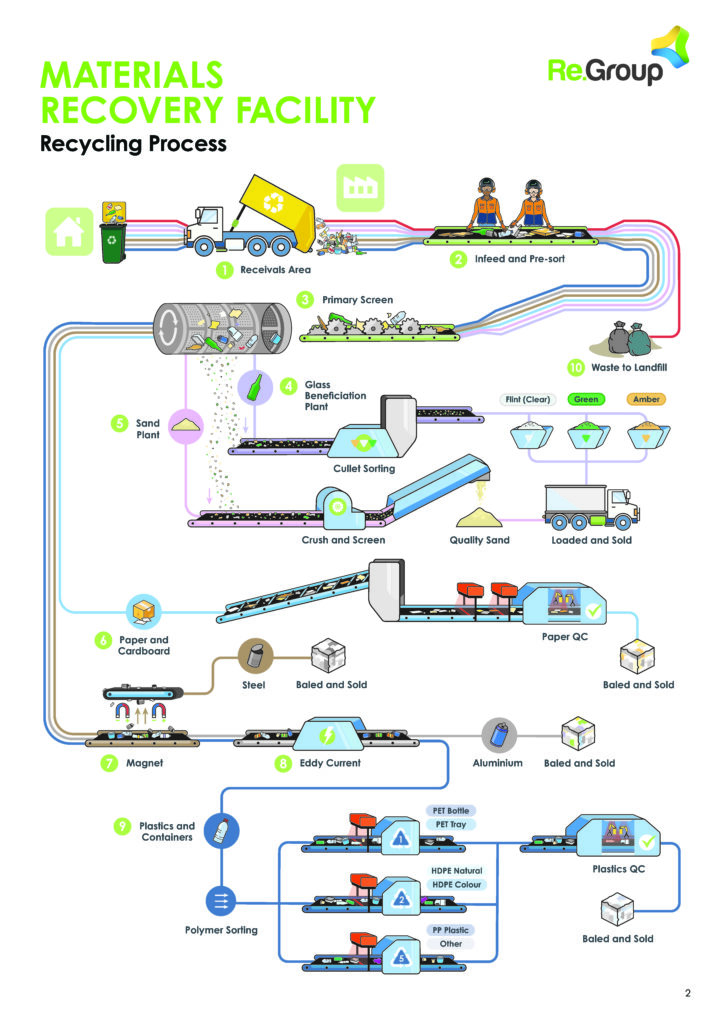
East Waste collects the recyclables from households and delivers them to a Material Recovery Facility (MRF). Mixed packaging materials are sorted into separate streams of glass, paper and cardboard, steel, aluminium, and plastic based on their properties such as size, shape, weight, density, magnetism and material type.
| 1. | Receivables Area Recyclable packaging materials are collected by trucks from homes and businesses and transported to the MRF where they are unloaded into the receivals area. |
| 2. | Infeed & Pre-sort Materials are inspected for gross contamination before a front-end loader lifts the material onto the first conveyor. Employees at a manual sorting station remove large contaminants and hazardous items. |
| 3. | Primary Screen Materials enter a primary screening process which separates materials according to their properties such as size, shape and density. At Adelaide’s Southern MRF (SMRF) the first screen is called an OCC screen, which has different decks with spinning metal stars arranged at different angles. Small items like broken glass fall through gaps between the stars, containers and cans fall through medium sized holes, and big items like paper and cardboard go through onto another conveyor. |
| 4. | Glass Beneficiation Plant (GBP) Broken glass and other small items from the primary screen can feed into a Glass Beneficiation Plant (GBP), or a Sand Plant. At the SMRF small pieces of glass are sent to a sand plant, which removes contaminants such as paper labels, metal and plastic caps. |
| 5. | Sand Plant Broken glass fines that cannot be made into new bottles are crushed until they are a similar size and shape as natural sand particles, without any sharp edges. This is then made into quality sand for use in infrastructure projects. |
| 6. | Paper & Cardboard Paper and cardboard from the primary screen pass over bounce conveyors and ballistic separators that shake out small pieces of contamination, and then through a series of advanced optical sorters to remove contaminants like film plastic. People or robots undertake a final quality inspection before the clean material goes to the paper baler. |
| 7. | Magnet The 3D materials from the primary screen and ballistics separator pass under a magnet that removes ferrous metals such as steel and tin cans, which go to the steel baler. |
| 8. | Eddy Current Separator Remaining 3D materials pass through the eddy current separator, which uses electromagnetic fields to excite non-ferrous metals (such as aluminium cans) and makes them jump off the belt into the aluminium baler. |
| 9. | Plastics and Containers – Polymer Sorting The SMRF has advanced optical sorting technology, which uses Near Infrared (NIR) scanners to identify the types of plastics based on the spectrum of light they reflect, and air jets shoot out the items based on types of plastic and colours, e.g., PET clear and coloured bottles, PET trays, HDPE natural, HDPE colour, PP plastic containers and other plastics. |
| 10. | Waste Non-recyclable waste from the sorting process is taken to landfill, while some items – like batteries and gas bottles – are too dangerous even for landfill and have to be specially collected. |
Download the printable factsheet (pdf) about the MRF processing here
Materials from East Waste’s Constituent Councils is processed at the Southern Materials Recovery Facility (SMRF), located in Seaford Heights. It is South Australia’s largest and most technologically advanced household recyclables processing plant. Developed by the Southern Region Waste Resource Authority (SRWRA) in a joint venture with resource recovery specialist Re.Group, the state-of-the-art facility was officially opened on November 8, 2021.
What happens to the sorted materials?

What happens to plastics?
Plastics are sorted into polymer types, then baled and sent to companies in South Australia and interstate where they are washed granulated and chipped. The plastic is then moulded into new plastic products including bollards, outdoor furniture and playground equipment.

What happens to paper and cardboard?
After being cleaned and sorted, the paper and cardboard resources are sent to both local and international markets (licenced operators only) to be made back into newspaper and packaging products.

What happens to glass?
Glass is separated into the different glass colours then sent on to be recycled into glass bottles, jars and other glass products as well as sand to be used in asphalt and concrete for civil works projects in South Australia.

What happens with metals?
Metals are collected and separated, mostly by magnets, then baled and sent to SIMS metal recycling facility, situated here in South Australia, to be remanufactured into new metal products.
Why is recycling important?
Recycling is great for our environment, economy and society!
Environmental benefits
Each time we recycle, we reduce the demand on our natural resources, such as trees, fossil fuels and raw materials mined from the earth. Recycling also reduces the amount of waste we send to landfill and pollution we discard into our environment.
Another benefit is the significant water and energy savings. For example, recycling aluminium saves 95% of the energy required to produce it from raw materials.
This figure is 70% for plastics, 40% for paper5and 30% for glass6.
Paper can be recycled many times, but if it’s sent to landfill, it breaks down to produce greenhouse gases instead. By recycling paper we help to reduce two of the contributing factors to global warming being deforestation and greenhouse gas production.
Economic and social benefits
Recycling contributes to our economy by conserving resources, reducing energy use and production costs as well as creating jobs. Recyclables are valuable and can be sold.
For every 10,000 tonnes of materials recycled there are 9.2 full time jobs created compared to 2.8 jobs when sent to landfill.

Recycling is cheaper than sending materials to landfill. If we reduce the amount of material sent to landfill then councils can pass on these savings to residents and invest in other community services.
Recycling materials through the yellow bin saves 60% of the cost of sending materials to landfill.
Recycling plays an important role in reducing our reliance on sourcing not only our own natural resources but also those from other countries. eg. Oil which is required for making plastic.
By investing time and effort into educating our children of the importance of recycling, they are more likely to adopt these habits and continue them in the future.
Recycling makes you happy! A study across 27 countries found that people who recycle have higher life satisfaction levels and are overall happier people.